bock machining gmbh

  • HOME
    • CONTACT
    • HISTORY
    • PHILOSOPHY
    • QUALITY AND CERTIFICATIONS
  • PRODUCTS
    • Shaft seal
      • Solid Radial Shaft Seals with Single or Multiple Sealing Lips
      • Radial Shaft Seal with Stainless Steel Housing
      • Radial Shaft Seal Elements with Flushing or Leakage Port
      • Radial Shaft Seal Elements with Pressure-Relieved Sealing Lips
      • Shaft Seal made of UHMW-PE
      • Shaft Seal, porous
      • Radial Shaft Seal with Shaft Sleeve
    • BELLOWS
      • PFAS-Free Bellows Made of UHMW-PE
      • Replacement for Bellows Made of PTFE Compounds
      • Bellows with Metal Insert
      • Rubber belows
    • DIAPHRAGMS
      • Machined Diaphragm
      • Die-Cut Diaphragm Made of UHMW-PE
      • Molded Diaphragms
      • Stamped Diaphragm
    • Plastic Lines
    • PISTON AND ROD SEALS
      • Spring-Energized U-Cup Seal
      • O-Ring-Energized U-Cup Seal
      • Memory Seals
      • Dry-Running Wiper Seals
      • Piston Ring
      • Complete Piston Assembly
    • SPECIAL SEALS FOR PAINTING TECHNOLOGY
      • Needle seal
      • Hose Pig
      • Control Piston
      • Needle Caps
      • Gate Valve Seals
    • VALVE SEAT, VALVE PLUG
    • PLAIN BEARINGS AND GUIDE ELEMENTS
      • Plain bearings and guide elements made from high-performance plastic.
      • Plain Bearing with Integrated Seal
      • Shift Gates
      • Trapezoidal Lead Screw Nuts
      • Plastic Coating
    • PLASTIC TURNED AND MILLED PARTS
    • ASSEMBLIES
      • Kolbenstangen-Führung
      • Gas Control Valve
      • Wiper Assembly
    • METALLIC SOFT SEAL
  • MATERIALS
    • Organor® – PFAS-Free High-Performance Plastics
      • UHMW-PE Ultra-High-Molecular-Weight Polyethylene
    • Enduflon® – Fluoropolymers
      • Enduflon V: PTFE – Polytetrafluorethylene
      • Enduflon M: Modified types of PTFE
      • Enduflon C: Compounds (mixtures) containing PTFE
      • Enduflon E: Paste-extruded PTFE grades
      • Enduflon T: Thermoplastic fluoropolymers
    • Naturon® – Bio-based Plastics
    • Oecomach® – Recycling of Plastic Waste Chips
    • Important Engineering Plastics and High-Performance Plastics
      • PE – Polyethylene
      • PEEK – Polyetheretherketone
      • PEI – Polyetherimide
      • PET – Polyethylene terephthalat
      • PPS – Polyphenylensulfide
      • PSU – Polysulfone
      • UHMW-PE Ultra-High-Molecular-Weight Polyethylene
    • MOCA Declaration of Conformity
  • INDUSTRIES
    • Food Industry
    • Beverage Industry
    • Painting and Adhesive Technology
    • Medical Technology and Pharmaceuticals
    • Rotary Joints
    • Pumps and Compressors
    • Valves and Fittings
    • Laboratory Technology and Analytics
    • Bulk Material Handling
  • SERVICES
    • Development and Design of Seals
    • Design and operation of test rigs
    • Failure analysis of seals
    • Conversion to PFAS-Free Seals

    • CNC manufacturing of plastic components according to drawing
  • BLOG
    • Permeation of UHMW-PE: Requirements in the Beverage Filling Industry
    • PFAS – the next Asbestos?
    • 3M’s Exit from PFAS
    • Hydrogen seals
    • PFAS: The restrictions could go even further.
    • “Elastic” Bellows and Diaphragms Made of PTFE
    • Plastic plain bearings with minimal play?
    • What can a product line made of pure PTFE do?
    • Does a scraper really remove “everything”?
  • WEBINARS
    • Live Recording » Webinar 1: The Use of PTFE in Specialized Sealing Technology
    • Live Recording » Webinar 2: UHMW-PE—The Underestimated Material
    • Live Recording » Webinar 3: Design of PTFE Bellows
    • Live Recording » Webinar 4: How to Design Membranes Made of PTFE and UHMW-PE?
    • Live Recording » Webinar 5: The Mantle Ring – “The Sealing of Horror”
    • Live Recording » Webinar 6: Sealing Hydrogen. How Does It Work?
    • Recording of Webinar 7 » PFAS-Free Alternative Materials to PTFE
    • Live Recording » Webinar 8: PFAS—What Action Is Needed in Sealing Technology?
    • Live Recording » Webinar 9: Design of Bellows and Diaphragms Made from UHMW-PE, a PFAS-Free Alternative Material
  • PFAS
  • CAREERS
    • EDUCATION
    • FINAL THESES
  • English
    • German
    • Italian
REQUESTHERE
PFAS Restrictions
Friday, 10 July 2026 / Published in Blog, PFAS

PFAS: The restrictions could go even further.

What PFAS-free alternatives are there to PTFE gaskets?

What means PFAS?

PFAS (per- and polyfluoroalkyl substances) are compounds in which the hydrogen atoms attached to a carbon atom have been completely replaced by fluorine atoms.

Within this subgroup of substances, PFOA (perfluorooctanoic acid) and PFOS (perfluorooctane sulfonic acid) have now been banned. These compounds (also known as fluorinated surfactants) are considered to be highly persistent. They have been detected in the environment, in the food chain, and even in humans.

At the European level, work is currently underway to impose restrictions or bans on additional PFAS.

Is PTFE also a PFAS?

Strictly speaking, this group also includes the chemically extremely stable fluoropolymers that are commonly used in sealing technology. Foremost among these is PTFE (polytetrafluoroethylene, Teflon®), which is the most important material. Far behind it are PVDF, PFA, FEP, PCTFE, and ECTFE, which are also used in chemically and/or thermally demanding applications.

See also:

➥ https://www.umweltbundesamt.de

➥ https://www.bfr.bund.de

Why has PTFE been used for seals up until now?

In the long term, therefore, the question arises as to which high-performance materials should replace the established high-performance material PTFE. Here, once again, are its most important advantages for industrial applications:

  • Chemically resistant to all substances
  • Can be used at both low and high temperatures
  • Physiologically safe
  • Low friction
  • Easy to clean

To date, there are few known alternatives to sealing and guide elements made of PTFE or PTFE compounds.

Can Teflon® be replaced with PFAS-free plastics?

Replacement materials for Teflon® seals should therefore have properties that are as similar as possible. The materials Enduflon P1 and Enduflon P16 from bock machining gmbh have what it takes. First of all, both materials are special variants of ultra-high-molecular-weight polyethylene (UHMW-PE). They stand out due to their simple chemical structure, which consists primarily of carbon and hydrogen atoms.

Enduflon P: Nachhaltige, PFAS-freie Dichtungswerkstoffe

Consequently, there is no significant environmental impact—in terms of raw materials, toxicity, or energy consumption—during either production or disposal. In fact, the chips can be recycled 100% without any problems. Furthermore, there are now several renewable sources that do not rely on fossil resources such as oil or natural gas. The desired sustainability is therefore the biggest advantage here.

Why is UHMW-PE so similar to PTFE?

Both materials share a one-dimensional, long-chain molecular structure that is very similar to that of PTFE. It is therefore not surprising that their advantages are nearly identical.

PTFE molecular chain

uhmw-pe molecular chain

Disadvantages of UHMW-PE?

Both plastics are notable for their excellent resistance to chemical attack. The only limitations arise when they come into contact with strongly oxidizing acids (e.g., nitric acid, chromic acid, or halogens). Due to the slightly weaker C-H bond (compared to the C-F bond), there are also temperature limitations.

Is it possible to improve UHMW-PE even further?

UHMW-PE has an operating limit of approximately 85°C under continuous operation. It can be used as a 1:1 replacement for PTFE in piston and rod seals (such as dry-running scrapers or spring-loaded groove rings).

UHMW-PE bellows, ultra-high-molecular-weight polyethylene diaphragm, PE 1000 sleeve, plastic bellows

The All-Purpose UHMW-PE.

In contrast, Enduflon P1 excels with its exceptional resistance to alternating bending, which makes it possible to replace PTFE bellows and diaphragms. Wall thicknesses can even be reduced thanks to its superior strength. In many applications, the service life of sleeves and bellows made from this special UHMW-PE is on par with that of Teflon bellows.

Why is UHMW-PE suitable as a sealing material?

Another major advantage is that the two replacement materials, P1 and P16, do not require any fillers to be wear-resistant. Even under completely dry operating conditions, they achieve an exceptionally long service life with low friction.

In coating technology, polytetrafluoroethylene is considered a so-called “coating-repellent substance” due to its wear particles. For this reason, special seals made of ultra-high-molecular-weight polyethylene in coating valves and pumps have been used for years to ensure compliance with the required LABS-free status.
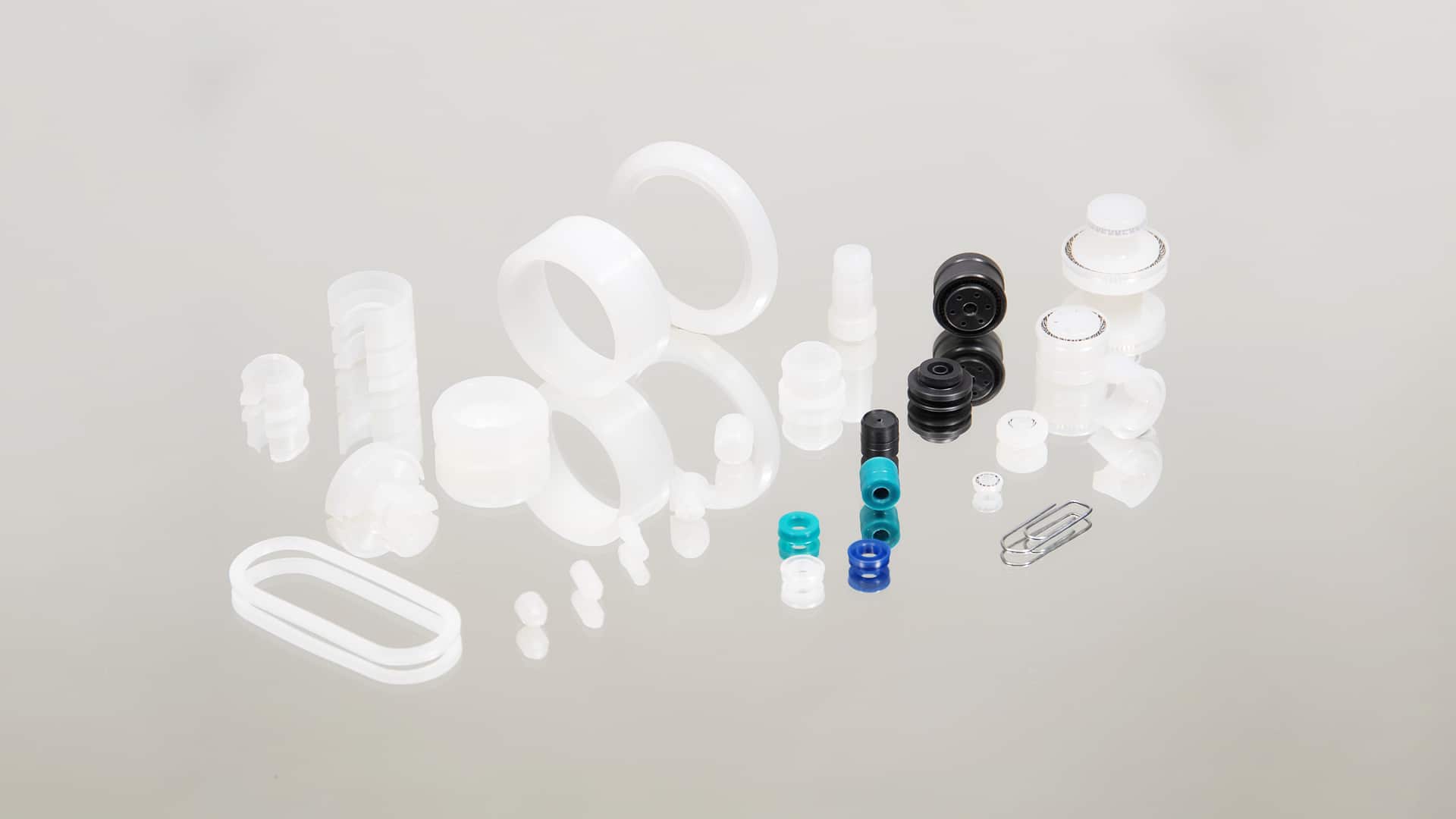
Can multifunctional parts also be manufactured from UHMW-PE?

Whether shaft seals (WDR), needle seals, or control pistons, the only limit to the imagination of the development team is the capability of machining. After all, these alternatives are also press-sintered materials that are not injection-molded. This generally makes it possible to easily replace existing sealing systems and mounting components with multifunctional solutions.

In short: The two materials, Enduflon P1 and P16, offer genuine PFAS-free alternatives to PTFE seals that stand out for their sustainability and nearly universal applicability.

What have been your experiences? I look forward to hearing from many of you!

Yours Stefan Bock

Teflon® is a registered trademark of The Chemours Company FC, LLC.

Tagged under: Blog, PFAS, UHMW-PE

What you can read next

PFAS – Per- and polyfluoroalkyl substances
PFAS
Plastic plain bearings with minimal play
Plastic plain bearings with minimal play?
Bellows and Diaphragms Made of PTFE
“Elastic” Bellows and Diaphragms Made of PTFE
Logo bock machining gmbh

CONTACT

LEGAL NOTICE

PRIVACY POLICY

© 2026 | bock machining gmbh

TOP
GDPR Cookie Banner

We are using cookies to give you the best experience on our website.

You can find out more about which cookies we are using or switch them off in .

  • German
  • Italian
Powered by  GDPR Cookie Compliance (opens in a new tab)
Privacy Overview

This website uses cookies so that we can provide you with the best user experience possible. Cookie information is stored in your browser and performs functions such as recognising you when you return to our website and helping our team to understand which sections of the website you find most interesting and useful.

Strictly Necessary Cookies

Strictly Necessary Cookie should be enabled at all times so that we can save your preferences for cookie settings.